From Wikipedia, the free encyclopedia
Hatshepsut[b] (/hɑːtˈʃɛpsʊt/ haht-SHEPP-sut; c. 1505–1458 BC) was the sixth pharaoh of the Eighteenth Dynasty of Egypt, ruling first as regent, then as queen regnant from c. 1479 BC until c. 1458 BC (Low Chronology) and the Great Royal Wife of Pharaoh Thutmose II.[10] She was Egypt’s second confirmed woman who ruled in her own right, the first being Sobekneferu/Neferusobek in the Twelfth Dynasty.
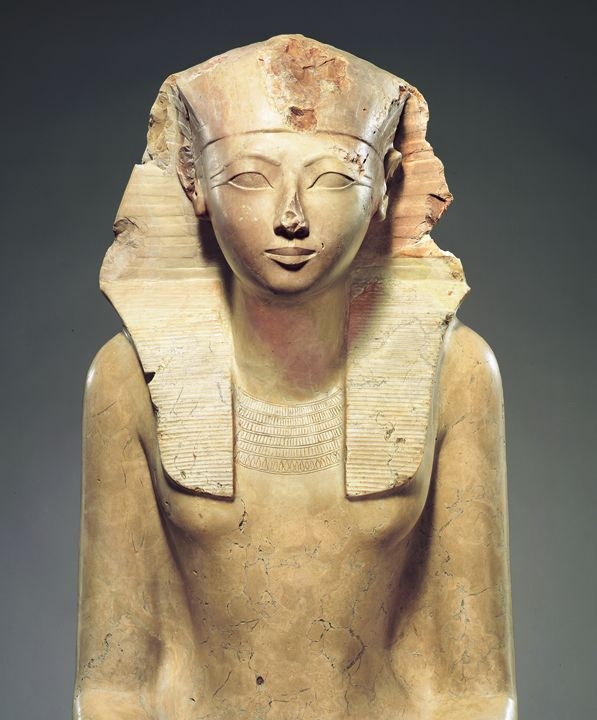
Hatshepsut was the daughter of Thutmose I and Great Royal Wife, Ahmose. Upon the death of her husband and half-brother Thutmose II, she had initially ruled as regent to her stepson, Thutmose III, who inherited the throne at the age of two. Several years into her regency, Hatshepsut assumed the position of pharaoh and adopted the full royal titulary, making her a co-ruler alongside Thutmose III. In order to establish herself in the Egyptian patriarchy, she took on traditionally male roles and was depicted as a male pharaoh, with physically masculine traits and traditionally male garb. She emphasized both the qualities of men and women to convey the idea that she was both a mother and father to the realm.[11] Hatshepsut’s reign was a period of great prosperity and general peace. One of the most prolific builders in Ancient Egypt, she oversaw large-scale construction projects such as the Karnak Temple Complex, the Red Chapel, the Speos Artemidos and most famously, the Mortuary Temple of Hatshepsut at Deir el-Bahari.
Hatshepsut probably died in Year 22 of the reign of Thutmose III.[12] Towards the end of the reign of Thutmose III and into the reign of his son Amenhotep II, an attempt was made to remove her from official accounts of Egyptian historiography: her statues were destroyed, her monuments were defaced, and many of her achievements were ascribed to other pharaohs.
Toward the end of the reign of Thutmose III and into the reign of his son, an attempt was made to remove Hatshepsut from certain historical and pharaonic records. Her cartouches and images were chiselled off stone walls. Erasure methods ranged from full destruction of any instance of her name or image to replacement, inserting Thutmose I or II where Hatshepsut once stood. There were also instances of smoothing, patchwork jobs that covered Hatshepsut’s cartouche; examples of this can be seen on the walls of the Deir el-Bahari temple. Simpler methods also included covering, where new stone was added to fully cover reliefs or sacred stone work.[80]
At the Deir el-Bahari temple, Hatshepsut’s many statues were torn down and in many cases, smashed or disfigured before being buried in a pit. At Karnak, an attempt was made to wall up her monuments. While it is clear that much of this rewriting of Hatshepsut’s history occurred only during the close of Thutmose III’s reign, it is not clear why it happened, other than as a manifestation of the typical pattern of self-promotion that existed among the pharaohs and their administrators, or perhaps to save money by not building new monuments for the burial of Thutmose III, and instead using the grand structures built by Hatshepsut.[81]
Amenhotep II, the son of Thutmose III, who became a co-regent toward the end of his father’s reign, is suspected by some as being the defacer during the end of the reign of a very old pharaoh. He would have had a motive because his position in the royal lineage was not so strong as to assure his elevation to pharaoh. He is documented, further, as having usurped many of Hatshepsut’s accomplishments during his own reign. His reign is marked with attempts to break the royal lineage as well, not recording the names of his queens and eliminating the powerful titles and official roles of royal women, such as God’s Wife of Amun. Some of these titles would be restored in the reign of his son Thutmose IV.[82]
Hatshepsut is, according to Egyptologist James Henry Breasted, “the first great woman in history of whom we are informed.”[85] In some ways, Hatshepsut’s reign was seen as going against the patriarchal system of her time. She managed to rule as regent for a son who was not her own, going against the system which had previously only allowed mothers to rule on behalf of their biological sons. She used this regency to create her female kingship, constructing extensive temples to celebrate her reign, which meant that the public became used to seeing a woman in such a powerful role. This ensured that when the oracle declared her king, the Egyptian public readily accepted her status.[86][page needed]
However, as with other female heads of state in ancient Egypt, this was only done through the use of male symbols of kingship; hence the description of Hatshepsut and others as female kings rather than queens.[87]